

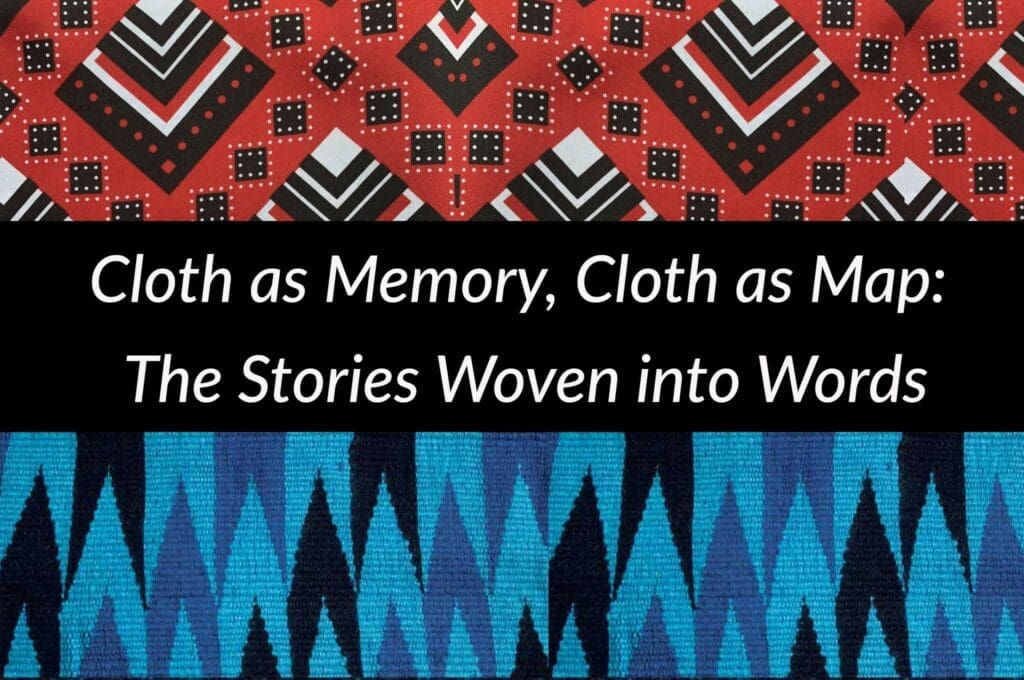
What if the cover of a book wasn’t just a cover? What if it was already telling the story, before you’d even opened the first page? That’s exactly what happens with the two collaborations between Alison Phipps and Tawona Sitholé. In both books, traditional cloth isn’t decoration. It’s a gateway.
Their first book together, The Warriors Who Do Not Fight, wraps itself in kente, the vibrant, handwoven cloth from Ghana that carries centuries of meaning in its patterns. The image chosen for the cover is niata, meaning “double-edged sword”: a sword that can be sheathed for peace or drawn for justice. For warriors committed to nonviolence, it’s the perfect symbol, holding the tension between struggle and compassion, readiness and restraint. Woven by unknown hands in Kumasi Bonwire, the kente reached the project through artist Naa Densua Tordzro and photographer Gameli Tordzro. There is something quietly powerful about cloth made by unrecorded weavers carrying a message across continents.
Their new collection, Folding a River, continues the conversation. This time the cloth is a retso, a patterned textile historically worn by hunters, gatherers, and travellers in southern African traditions. People on the move. People learning to live with the land, to negotiate its gifts and its difficulties. The retso speaks of attentiveness, resilience, and respect, qualities that run through every poem in the collection. Cloth, for Tawona, is another form of expression. For Alison, it’s a cultural text that travels across borders, uniting people in ways we feel and see rather than in ways we speak.
In Folding a River, water carves and reshapes the landscape; cloth does the same, gathering, folding, and protecting as it travels, woven through crossing threads, just as the poems emerge through crossings of voice, history, and place.
Together, the two books make a quiet but insistent argument: that knowledge about migration, survival, and belonging isn’t only found in written words. It lives in thread and pattern, in garments worn and passed on, in the textiles that remain when other traces of home vanish.
Which brings us to a lovely footnote, or maybe a hint of what could follow.
Did you know there’s an official Refugee Tartan? Created with the Scottish Refugee Council, its colours were chosen to represent, in the words of CEO Sabir Zazai, “the richness and diversity and the unique colours and flavours that refugee communities have brought to Scotland over the years.” It’s a tartan about refugees, yes, but also about Scotland, and about the values of compassion and welcome woven into its fabric.
A kente from Ghana. A retso from southern Africa. A tartan from Scotland.Three textiles. Three traditions. One continuing thread about what it means to carry culture, not as something fixed in a museum case, but as something lived, worn, and remade with every generation. Now we just need Alison and Tawona to write a third book, so we know exactly which cloth to wrap it in.
Jane Darroch Riley from Wild Goose Publications.
 USA North East