

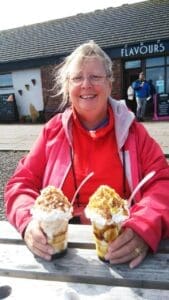
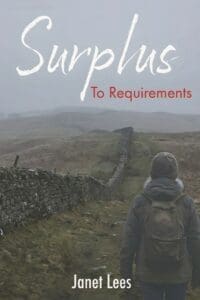
Surplus to Requirements is the debut novel from Janet Lees, published by Wild Goose Publications, the independent Scottish press rooted in the Iona Community’s tradition of justice, inclusion and spiritual imagination. We sat down with Janet to find out how a 79-year-old woman on the run became one of fiction’s most compelling new voices.
The title Surplus to Requirements is both striking and unsettling. What first led you to that phrase, and what does it mean to you?
The idea that people might be ‘surplus to requirements’ came up when the Assisted Dying Bill began to be debated. Older people and people with disabilities and long term health conditions began to express how this was being applied to them. I’d already heard the phrase several times in respect of my own employment and that of others. It’s a degrading phrase and should not be used about human beings.
The novel imagines a future Britain where older people are legally required to die. Was there a particular moment, conversation or news story that first sparked the idea?
My father had been living with a disability and complications of long term health conditions for many years. He died at the beginning of 2026 aged 94. He was very feisty and determined to live. ‘I’m still breathing,’ he would tell me. The debate about Assisted Dying was short on safeguards concerning older people, those with disabilities or health conditions. The proposers did not appear to respect the view of disabled people’s organisations, medical and health organisations that said it seems unsafe. Coercion, a very real experience for many, was underplayed.
I have worked as a speech therapist with children who have communication difficulties and their families. I could see all too clearly that their wishes would be ignored.
The Assisted Dying Debate, so often celebrity led, is all about ‘Me, Me, my choices’, rather than building a community in which people are safe and cared for and have their wishes respected, including appropriate palliative care and pain control. Surely we can build a society in which people want to choose life, not death.
Although the novel is set in 2050, many readers will recognise echoes of debates happening today. Were you consciously writing a warning, or did the story emerge in a different way?
I did that on purpose. It’s our current society that is slipping into this pattern, and has been for some time. The novel is set not too far into the future, just enough to make it possible that a Required to Die Act might be brought in by a regime that has no respect for human beings.
The Old’un is a remarkable protagonist. How did her character develop, and what drew you to tell the story through the eyes of an older woman?
People tell me the Old’un is essentially me. There are few stories told through the eyes of 79 year old women. Even dystopias usually feature younger adults. Almost none have children with disabilities amongst their cast of characters. When I worked for Scope (a charity which campaigns for disabled people) about 20 years ago, they used to say how important representation is. Those who care for older or disabled family members get it, but it seems too many don’t. Disabled people and older people are too often seen as a ‘social burden’. We must challenge such attitudes; see the world through their eyes.
Throughout the novel, the Old’un encounters people who continue to show kindness, even in a society that seems to have lost its moral compass. Why was it important for compassion to remain at the heart of the story?
Because this is surely the calling of the faith community. Faith is continually relegated and abused in our society. Unfortunately too many reports of abuse and degeneration have emerged about faith communities and often we have lost our calling. In the Assisted Dying Debate people of faith were constantly put down as having outdated views out of step with society as a whole. Compassion is one mark of the Gospel of Jesus Christ: blessed are the merciful. Let’s keep that central to our calling.
The novel insists on the value of people who are often overlooked or dismissed. Is that conviction rooted in your faith, your experience, or both?
At 67 it’s all the same thing now, a continual interplay of faith and experience reeling back and forth in my life. I used to call myself Speech Therapist Theologica and said ministry and speech therapy were both the same thing. It was as much a vocation as my call to ordained ministry. When I became surplus to requirements to the denomination I served I decided to write the book, a reinvention of my call from God to support those overlooked ones. This is the result.
Memory, storytelling and faith all play important roles in the novel. What connects those themes for you?
They are resources I use every day. For over 30 years I’ve used and written about the remembered Bible; that version that resides in us and motivates our lives. I’ve told stories all my life and they are an important part of the ministry I’ve shared. Recently in Ireland I saw this quote, taken from early Irish Gaelic: Tradition is not about guarding the ashes, but keeping the flame alive.
Wild Goose Publications is also proud to have published several of your non-fiction titles, including Come Wind, Come Weather, your account of walking the length of Britain as a pilgrimage. Did you plot Surplus to Requirements before or after that journey — and were there particular landscapes or routes that shaped the path the Old’un takes?
The two books are closely connected. I walked the End to End in 2019 when i left my job (I can’t say retired because the current government policy meant I couldn’t claim my state pension until 2024 so I had 6 years without a pension). The End to End was about putting myself back together: Christ beside me, Christ before me, Christ to comfort and restore me. I needed to know that an Old’un could walk a long way. The plotting of Surplus to Requirements was something I had to learn as I’d never written fiction before. I’d walked Hadrian’s Wall path before the End to End in 2017. It’s a wonderful route – very atmospheric and gives itself to storytelling. A UNESCO World Heritage Site, it is one of the things the Romans did for us and quite possibly one of the ways the story of the Crucified One first came to Britain.
The novel contains moments of darkness, but also humour, friendship and hope. How did you balance those elements while writing?
That was quite hard. The chapter set in York is very violent, but then York isn’t all about chocolate. It does have a violent history: several sieges and cholera epidemics. These things are taken from the history of the North, like the Harrying of the North in 1068/9 AD.
No story can be all sweetness and light. As for the chapter about York, the global situation for women is of serious concern. In many countries women’s rights are non-existent or being rolled back. Misogyny and violence towards women and girls is a global concern. Yes it could happen in Britain, just like the section about the small boat travellers or ‘returnees’ from Ireland to Scotland echoes social fears about immigration. We act as if all these things are about ‘them’ not ‘us’. Well, think again.
Many dystopian novels focus on technology or political control. Your novel seems more concerned with how societies decide whose lives matter. Why was that the question you wanted to explore?
I’m not very techy so that was out. I needed a context in which tech had been rolled back, something older people might find more congenial. The novel is about political control but that control is not named. I called it The Regime but we’ve certainly seen it before and sometimes it wears a shirt of a particular colour. The euthanising of children with disabilities has happened before (a recent report has it happening in Cumbria within my lifetime). I’ve lived and worked with people with disabilities all my life (my father had a lifelong disability). Each of us is likely to find impairments increase with age. So does that make us surplus to requirements?
The church in Britain has largely majored on being a monogenerational community for older people as fewer children and young people engage with it locally, and where they do it offers little support. I’m very aware that can be quite effective. The charity sector in Britain offers support to people with all kinds of conditions. Just look at the starting line-up for the London Marathon. The Hospice movement is mostly supported by public donations. All of these observations pose the question: What matters?
Readers from different backgrounds may engage with the novel in different ways. What conversations do you hope the book will start?
I’m fortunate to have already had some conversations about the book, mostly with members of the Lay Community of St Benedict, for which I’m grateful. They valued the retelling of the stories of the saints in various forms and the integration of spirituality and fiction. People do pray, so why not in a book? I strongly believe the Gospel will still be a feature of our shared culture. What stories we tell to encourage this are important. What story would you tell about the Gospel in Britain in the 21st century?
The Old’un carries stories with her throughout her journey. Are there stories, books or writers that have travelled with you over the years and influenced your own imagination?
I survived ordination training in Oxford in the late 80s/early 90s by reading The Wild Girl by Michelle Roberts. It’s a fictional gospel of Mary Magdalene. It was one of the first fictions like that I’d encountered but there are many more now. Earlier, in my mid 20s, I read Julian of Norwich and loved her insights. But I’m also at home with Hilary Mantel (she grew up in the village where I now live) and Wolf Hall – that was a very turbulent time too. I first read 1984 by George Orwell for my O Level English. I read all of the time.
A slightly selfish question, but an important one. Wild Goose Publications is an independent press with a mission we care deeply about: publishing voices that might not find a home elsewhere. As one of our authors for many years, what does it mean to you to have this novel published here? And do you have a favourite Wild Goose title, your own very much included?!
It is hugely important to me that Wild Goose agreed to publish this book. I first self-published because I wasn’t sure they would (violence, strong language might stand in the way). It’s very different from other things I’ve had published by WG. I like to offer to contribute to as many WG worship books as I can. This book belonged with WG.
From my early twenties I loved WG books. I used their simple worship formats and wrote my own. My favourite WG book must be Kate McIlhagga’s Green Heart of the Snowdrop. She was a friend of mine.
Finally, if readers take away just one thing from Surplus to Requirements, what would you hope it might be?
Hope.
 USA North East