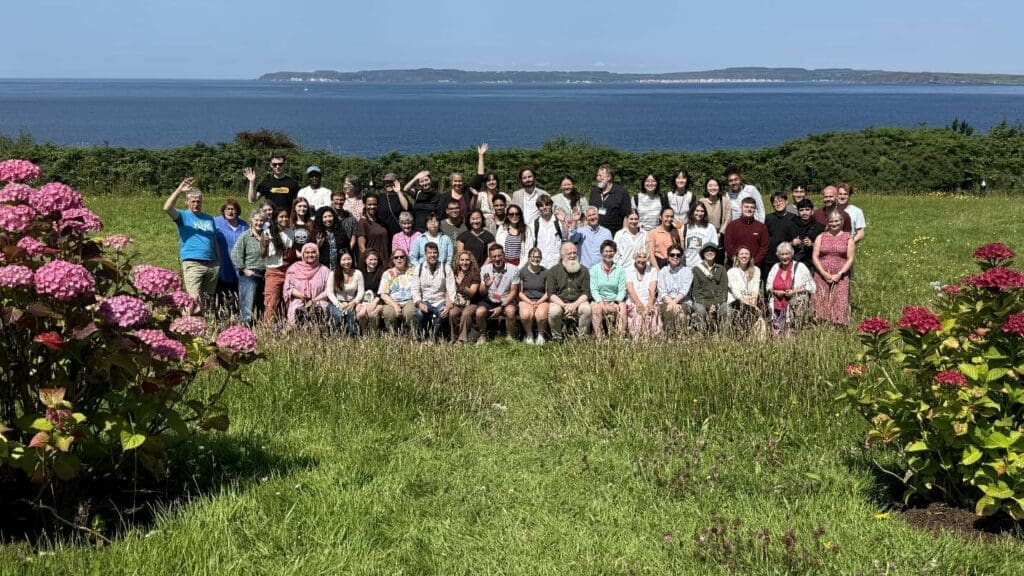
Corrymeela Learning Community, credit: Ruth Quill
Ruth Quill, from the Iona Community’s Young Adult Group, shares reflections from the Learning Journey week with the Corrymeela Community.
As a member of Young Adults Group, I was recently invited to Corrymeela to represent the Iona Community at a programme week called the Learning Journey. I’m sure I’m preaching to the choir here but in case you are unfamiliar, Corrymeela is a centre and community promoting peace and reconciliation in Northern Ireland, founded in 1965 which was modelled on the Iona Community. They were really active during the Troubles, facilitating mediation and connection between opposing groups of people, and continue their work today through a variety of hopeful programmes and resources.
The Learning Journey brought attendees from across the world, from Scottish psychologists to New Zealand diplomats, to Palestinian journalists to South African charity leaders. The content was based on a collection of resources from Corrymeela called Nurturing Hope which are available online as open access documents. To summarise the sorts of things we were up to, our days started with a lecture or panel discussion on a certain conflict zone or peacebuilding topic, and continued with workshops such as conflict roleplays to consider how we build peace in our lives and our communities.
I’d never before been somewhere which housed such a variety of life experiences. The conversations were hurried as people tried to glean as much wisdom as they could from their ally across the globe. The building itself teemed with ideas and was clearly intentionally designed to be able to carefully hold all the frustrations, breakthroughs, disagreements and heartaches that arose from the sessions.
It was a real honour to be in a place of such importance to my Northern Irish family and to represent the Iona Community to so many people from around the world. I enjoyed many conversations about the Iona Community with curious people, encouraged to hear of another community of people pushing the needle for justice. I also picked up several nuggets of wisdom, workshop ideas and hope-fuelling wins which I was able to share with the young people who attended the peacebuilding-themed Youth Week at the Abbey.
I can’t distil all that I learned there for you in this short blog, so I thought instead I would give you the anecdotes that have stayed in my mind since leaving there in July. I will leave out the speakers’ information, however if you would like to learn more about these or anything else I’ve spoken about, please reach out to me.
“I worked with a Columbian jungle community whose resources were destroyed in the civil war. They shared that while things had improved slightly since 2016, that their children now had phones which meant their structures of living no longer worked. They also shared that while they yearned for more change, to bring about change they needed to train to Columbian law. No meeting in the middle.”
“I started a project called Drawing Hope which aimed to unite Korea by asking children in South Korean schools to introduce themselves to North Korean children by drawing self-portraits and pictures of what they’d like to do together if they were to meet. We sent these images to North Korean authorities who sent drawings back and helped facilitate the children meeting each other, sending them across the border in a rare moment of contact.”
“We started ‘Good News’ – a newscast focused on positive news. We broadcast this into South African schools after the apartheid and saw a significant decrease in rates of depression.”
“I spend five minutes alone with my sacred self before going into conversations with my mother. It’s not something that affects her; it’s just something that I do with what I’ve got available to me.”
“On a Zoom call with Bethlehem for Peace and Justice, they stopped me when I asked what gives them hope. They said that people jump to hope too easily and explained to us their theology of anger. I have since then always begun my work by weeping and shouting alongside people.”
“Cheap hope can mask despair. When I witnessed a massacre on my way back from school, I had to give myself permission not to be hopeful while my life went on pause. My hope is not that the situation in Iran will improve, it is that I kept walking home.”
 USA North East