Learning Again How to Listen
In an age of endless commentary, constant updates and shrinking attention spans, there is something quietly radical about a sentence that asks us to stop and reflect.
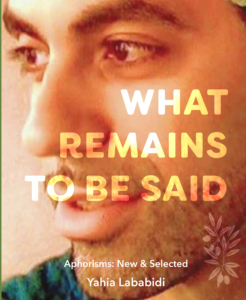
This is part of what gives Yahia Lababidi’s What Remains to Be Said its unusual power. The book gathers aphorisms, brief reflections that sit somewhere between poetry, philosophy and prayer. Small in size, perhaps, but not in ambition.
Lababidi recently described aphorisms as “fragments that carry the weight of reflection and the pressure of silence,” adding that “in an age of haste and constant address, such brief utterances offer a pause, a place where thought can gather its strength before speaking.”
That sense of pause runs through the entire collection.At a time when language is often used to provoke, perform or overwhelm, these short meditations move in the opposite direction. They ask for attention. And gift us a deeper kind of attentiveness — to the self, to suffering, to mystery, to the sacred dimensions of ordinary experience.
In his preface to the book, writer and AGNI editor Sven Birkerts observes that we live in “the age of the eye-roll,” a culture often uncomfortable with inwardness, contemplation or open spiritual searching. Yet that is precisely the territory Lababidi enters without apology.
Again and again, the aphorisms return to silence, mercy, attention and spiritual perception:
“In silence we honour the unsayable.”
“Social media: the voice that drowns out the voice inside our head.”
“The poet does not address the active, scattered person but rather the contemplative individual seeking wholeness.”
The collection never rushes toward certainty. Instead, it creates space for reflection to unfold slowly. Some aphorisms read like spiritual observations, others like poetic koans or fragments of hard-earned wisdom. Many linger in the mind long after reading.There is also something deeply humane at the heart of the work. Beneath the wit and compression lies an insistence on compassion, inward honesty and shared humanity:
“If we look at ourselves deeply, we pardon others. If we look even deeper, we realise there are no others.”
Perhaps this is why aphorisms feel newly relevant now. In a noisy and fragmented world, they resist excess. They do not shout for attention. They simply wait for a reader willing to listen.
Or, as Lababidi himself writes:
“All languages are rough translations of our native tongue: Spirit.”
The book is available in print or download form
Jane Darroch Riley from Wild Goose Publications.
 USA North East