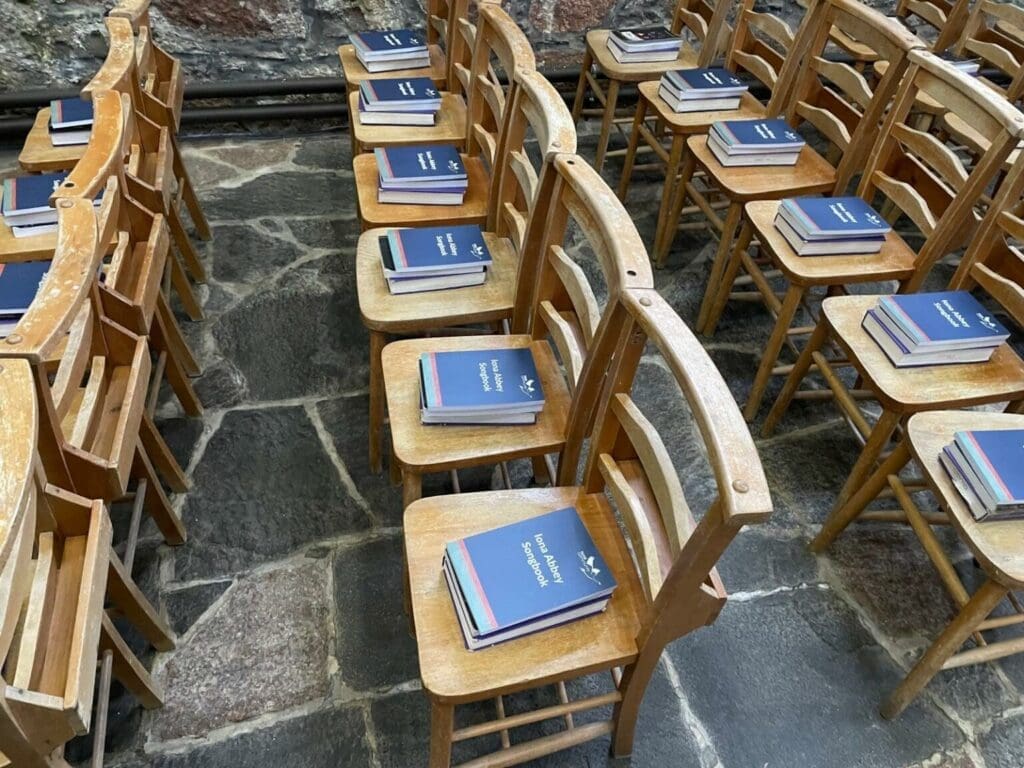
Iain McLarty, from the Wild Goose Resource Group, shares reflections on the process of compiling a new songbook for Iona Abbey.
For the last year Iain has been working on a new songbook for Iona Abbey. He has been doing this alongside our wonderful former WGRG colleagues John Bell and Alison Adams as the editorial team. Also involved are Wild Goose Publications, and a wider group of members and staff who have helped guide the song selection and editorial policy.
The book will be published later this year and gather more than 300 songs organised around the Abbey’s pattern of prayer. A vast majority of the material has been written by members and friends of the Iona Community. The fact it is even possible to bring together a collection like this is a witness to the creativity in worship which the Iona Community has enabled and inspired over the decades.
One of the main aims of the book is to make sure that all the songs are written in contemporary and inclusive language. This involves revising many songs as our understanding around language keeps evolving. This is much more challenging in songs than in other texts, as metre, rhyme, scansion, alliteration, and many other factors come into play. The issues that arise touch on many areas of common concern for the Iona Community and in this sense we can see revisions not as a negative, unnecessary tinkering with old favourites, but as a way in which we live out our commitment to justice and peace and practically demonstrate radical hospitality.
Some of the decisions are fairly simple within an Iona Community context. For example, it seems clear that we avoid masculine pronouns for God unless referring specifically to Jesus. However, other masculine language such as ‘Lord’ can be more contentious as it developed in Christianity as a term of resistance to empire and earthly rulers. A blanket policy on removing ‘Lord’ would also make it almost impossible to sing many liturgical texts or many songs from the majority world. We’ve instead tried to change as many instances as possible to soften the dominance of that language and to offer new possibilities.
Another fairly clear decision was that any language about people should ensure that people of any gender feel included. That means that songs such as “Brother, sister let me serve you” have been revised, and in that case there is a widely used alternative of “Will you let me be your servant?”.
However, there are also specific references which are important to retain. For example, “the women learn how to dance without a partner” in “If the war goes on” highlights the experiences shared by Argentinians who lived under military dictatorship in the 70s and 80s. Similarly, “feel for the women whom men have defiled” in “Christ’s is the world in which we move” acknowledges the awful reality that women are significantly more likely to suffer from gender based violence.
The language of faith and of congregational song is rich in metaphor and this appeals to our inner poet. But it can also become exclusive when people who have often been marginalised feel that common metaphors reinforce this marginalisation.
One example is the longstanding use of darkness as a metaphor for evil, a linguistic convention that has come under increased scrutiny in recent years because of concerns about its potential racial implications. This also parallels a trend in theology to explore where darkness can be a positive, and including songs which touch on this is an important way to tackle the concern as much as revising negative uses. Another example is the widespread use of language around blindness and deafness as a metaphor for incompleteness or ignorance which is at odds with contemporary understandings of disability.
These examples provide a flavour of the discussions around language which we are in the middle of during this editing process. In many ways though, talking about the issues which emerge is just as important as revising texts so hopefully this short piece will encourage thought and discussion. While we might not agree on every linguistic detail, it is through grappling with these concerns together that we bring about change.
 USA North East