‘Poetry keeps hope alive.’
Nazmi al-Masri, Professor of Languages at the Islamic University of Gaza shared these words at a recent Wild Goose Publications book launch. ‘Let’s Throw Away War’, a collection of poems by young Palestinian poets, complements ‘Folding a River’ by Alison Phipps and Tawona Sithole. You can read about these volumes in this Guardian review. For now, let these words be a reminder that in the midst of suffering, and rage we recognise glimmers of hope, kept alive in poetry, prayer, courage and resilient actions for justice and peace.
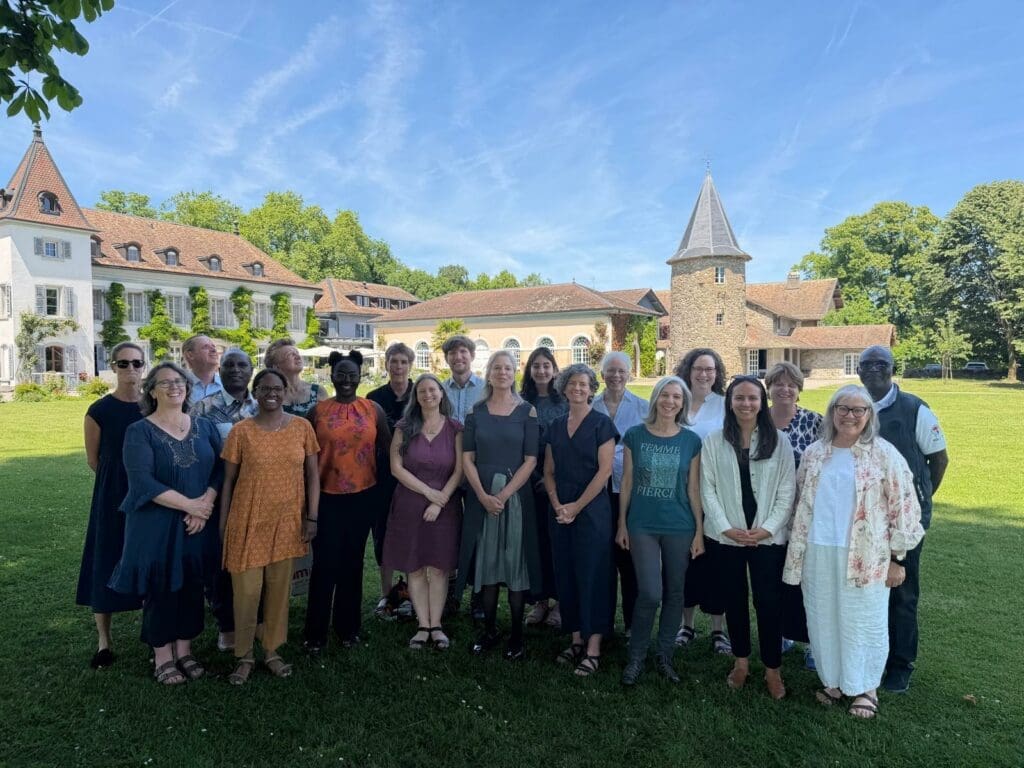
The annual gathering of Members, this year in Paisley, for the hallowing of New Members and the celebration of all that it means to ‘live together in community’, is coming up later this month. We give thanks to God for the gift of each New Member; and we will remember with gratitude the lives of those Members who have gone before us. We will spend time online and on site, in worship. We will hear news of our global membership. And we will share deeply about the work of our nine Common Concern Networks.
I write this piece as I travel home from a weekend spent in ‘Meeting for Worship for Business’ with the Quaker United Nations Committee in Geneva. On Friday evening we heard from Ambassador Matthew Wilson of Barbados about the erosion of the values of the UN in the face of severe cuts and a vacuum of moral leadership. In the midst of this shrinkage, he pointed us to four signs of hope:
- Engaging with difference – with increasingly polarised leadership, there are increasing examples of States working well with difference.
- Emerging partnerships – small and medium sized States are finding deeper partnerships where once all such partnerships coalesced around the mighty monolithic players.
- Re-awakening – populations around the globe are leading a grassroots reawakening of injustice – notably, the inter-generational actions protesting single-use plastics.
- Strategic alliances – with the collapse of the US support for the UN greater strategic alliances are developing between States and civil society – this is where religious organisations have a key part to play
He finished his reflections by praising the expertise of the team of Quaker Representatives who host Quiet Diplomacy work (under the radar conversations between States in advance of key UN debates): “A safe space without technical expertise is a park. This is not a park.”
Our Common Concern Networks (CCNs) are perhaps a little like this: ‘safe spaces with technical expertise’. I commend all in our CCNs for the work that you do. To paraphrase Ambassador Wilson, this is not ‘a walk in the park.’ You bring a heady mix of expertise and lived experience in your given field, alongside your passionate, active faith in a God who seeks justice and peace, to a world where space for such conversations and action on the global political stage is shifting dramatically.
These words from Gazan poet Hanna Jalal al-Kafarna remind us that in the face of devastation, there is hope for justice and peace:
‘They plunder your sleep, destroy your peace,
Their crimes scream loud, just cease!
They burn your world, then dance so free
Above your pain and destiny.
But still my voice breaks the night,
I fight, I fall, I rise, I write.’
Hanna Jalal al-Kafarna
extract from Defiant Darkness
Folding a River
The companion book to 'Let's Throw Away War.'
A sweeping poetic testament to migration, memory and the fragile work of hope. These poems speak to displacement and belonging, to wounds that demand tending, and to the courage required to remake community.

 USA North East